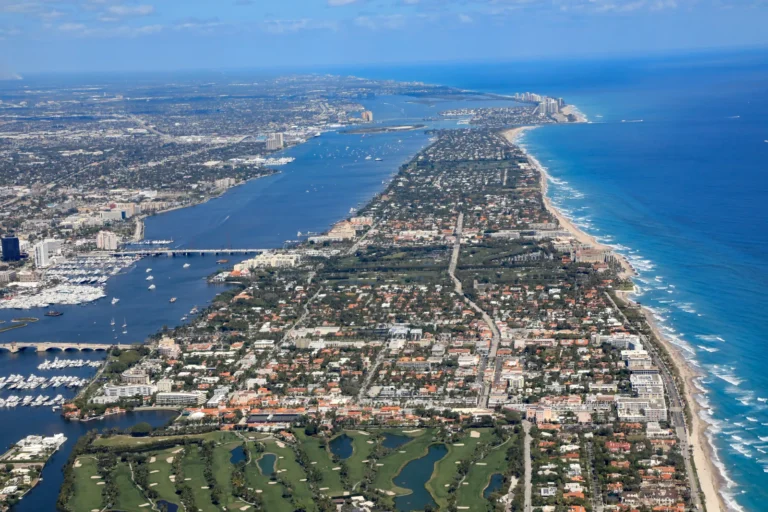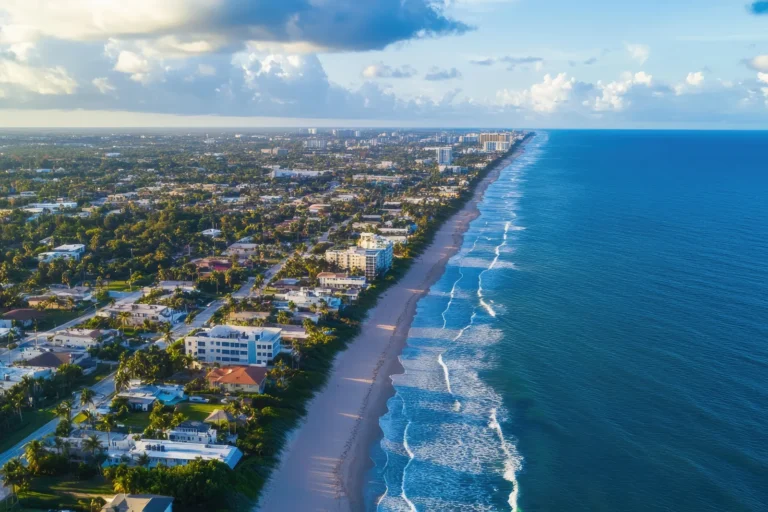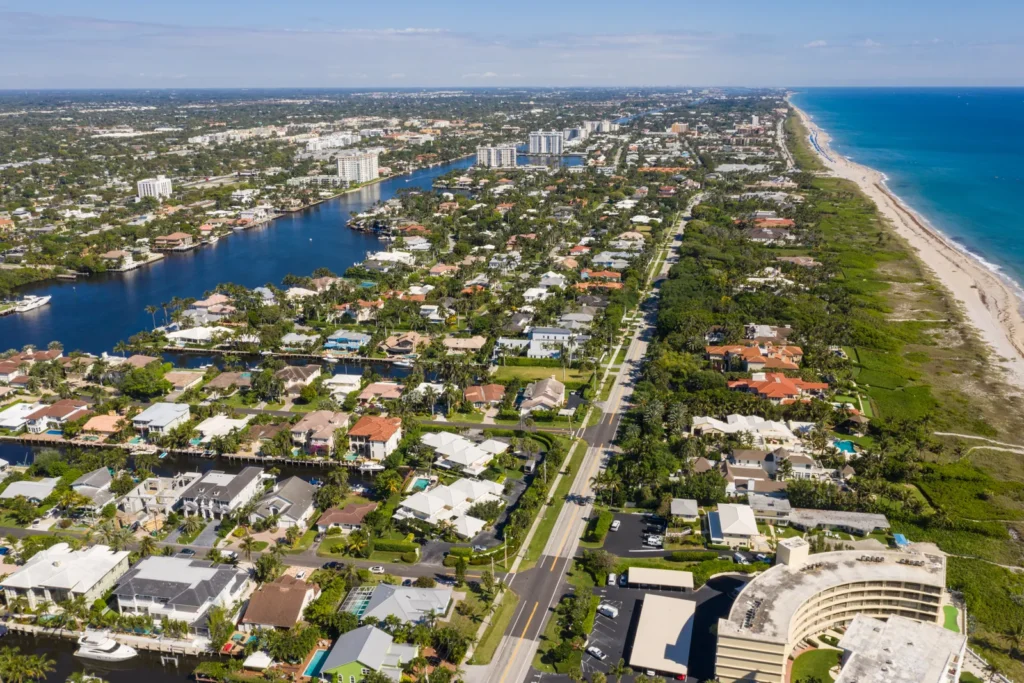
Boynton Beach is a Palm Beach County city with Intracoastal Waterway frontage, and three things shape most purchases there: flood-zone rules, the city’s 25-year recertification program for larger condo buildings, and the city millage rate on the tax bill.
This guide covers the waterfront, flood and storm rules, condo and permit requirements, property taxes, schools and transportation for Boynton Beach, Florida. Each rule is linked to the city, county, state or federal office that publishes it.
What are the basic facts about Boynton Beach, Florida?
Boynton Beach is the third largest municipality in Palm Beach County, according to the City of Boynton Beach’s own overview. The table below collects the figures a buyer usually needs first.
| Item | What the official source says |
|---|---|
| County | Palm Beach County |
| Population | Approximately 80,139 residents (the city’s published estimate) |
| Land area | 16.157 square miles, per the 2020 Census Gazetteer |
| Incorporated | April 14, 1920, as the town of Boynton; renamed the City of Boynton Beach in 1941 |
| School district | The School District of Palm Beach County |
| Highway access | Three I-95 exits (Woolbright Road, Boynton Beach Boulevard, Gateway Boulevard) and the Florida Turnpike, per the city |
| Rail | A Tri-Rail station, per the city |
How did Boynton Beach get its name and boundaries?
The town of Boynton was incorporated on April 14, 1920, according to the city’s historical information page. The city’s archive collection note adds the rest of the sequence: the town split in 1931, the land east of the Intracoastal took the name “Boynton Beach,” and in 1938 that eastern land became Ocean Ridge. In 1941 the original town west of the Intracoastal became the City of Boynton Beach.
That history matters when you read an address. Ocean Ridge is a separate town, and the city’s own Oceanfront Park page lists the park’s location under Ocean Ridge. Confirm the municipality, and therefore the building department and tax district, before you assume a beach-side property is inside the city.
What water access and parks does Boynton Beach have?
The city reports five parks on the Intracoastal Waterway and 250-plus acres of beach, natural conservation land and parks, according to its overview page.
- Boynton Harbor Marina: The city’s overview page says the marina is owned and operated by the Community Redevelopment Agency. It sits half a mile south of the Boynton Inlet and offers marine fuel, boat and jet ski rentals on the Intracoastal Waterway and fishing and diving charters, per the city’s marina page.
- Oceanfront Park beach: Open 365 days a year from sunrise to 9 pm, with lifeguards on duty daily from 9 am to 5 pm and designated surfing and skim board areas at the north and south ends, per the park page.
If a home’s appeal is boat access, ask for the dock and seawall permit records in writing.
How do flood zones affect a Boynton Beach home purchase?
Flood zones change what you can build, what a lender requires and what insurance costs. The city’s flood hazard page groups zones as follows.
| Zone | City description |
|---|---|
| AE | High risk: the base floodplain where base flood elevations are provided |
| VE | High risk, coastal: 1% or greater chance of flooding plus an added hazard from storm waves |
| X (shaded or unshaded) | Moderate to low risk; unshaded X is an area of minimal flood hazard |
Boynton Beach’s floodplain regulations set three rules worth knowing before an offer:
- New residential construction and substantial improvements in the floodplain (the Special Flood Hazard Area) must have the lowest floor elevated to the base flood elevation plus one foot.
- A substantial improvement or substantial damage is any project or loss costing 50% or more of the building’s market value, and a structure in the Special Flood Hazard Area must then meet the same flood protection standards as new construction.
- The elevation certificate is part of the permit record and must be submitted before a building may be occupied.
When LPE Realty reviews a Boynton Beach purchase, the first document we look for is the elevation certificate, because it ties the home’s lowest floor to its mapped flood zone. The city’s flood information page points owners to the Palm Beach County Flood Zones Interactive Map and to the city’s Development Department for parcel-specific floodplain data, and notes that flood insurance is required by law to obtain federally backed financing, which it says includes most conventional mortgage loans, for a structure in a flood hazard area.
The city’s Community Rating System page says the Class 4 rating took effect October 1, 2026, and states that it raises savings to 30% for properties in a Special Flood Hazard Area, with a 10% discount outside it. The same page and the flood information page still carry the older 25% figure, so confirm the current discount with your insurer. Florida also requires the seller of residential property to provide a flood disclosure at or before the time the contract is signed, under Florida Statute 689.302. For the insurance side, see our windstorm and flood insurance due diligence guide.
What should I know about hurricane evacuation zones and storm repairs?
An evacuation zone is not a flood zone. Palm Beach County defines evacuation zones as areas that may be inundated by storm surge or a sudden push of water ahead of a storm, and separates them from flood zones, which cover risks such as poor drainage and sheet flow. Look up an address with the county’s Know Your Zone lookup tool.
Repairs after a storm follow city rules. The city’s post-storm permitting page says roof replacement or substantial roof repairs need a permit, debris removal does not, and Florida licensed contractors may do emergency repairs but must apply for permits the next business day.
Small-project exemptions have a limit. The city’s House Bill 803 page describes two single-family permit exemptions that require a written request. Neither applies to a property partly or entirely in a flood hazard area, and the minor-work exemption also excludes structural, electrical, mechanical, plumbing and gas work.
What condo, permit and planning rules apply in Boynton Beach?
Boynton Beach runs its own building recertification program. The city’s recertification page requires recertification at 25 years for qualifying buildings, then every 10 years. It covers condominium and cooperative buildings of three or more stories and other threshold buildings, and exempts single-family, two-family and three-family homes and townhomes of three or fewer habitable stories. The city says the program was modeled after Miami-Dade County’s program.
State law runs alongside it. Florida Statute 553.899 requires a milestone inspection of condominium and cooperative buildings of three habitable stories or more by December 31 of the year the building reaches 30 years, and lets a local enforcement agency set 25 years based on factors such as proximity to salt water. When LPE Realty reviews a Boynton Beach condo purchase, we ask for the building’s inspection and recertification status before we talk about anything else. Our milestone inspection and SIRS guide explains the state side.
Permits and zoning are handled online. The city says all new permit applications after May 22, 2021 are processed in SagesGov, and its permit page notes that older application numbers formatted like 21-3000 run through a legacy system. The city’s zoning map tool lets you find a parcel’s zoning district, future land use designation and setbacks. The city’s Comprehensive Plan 2050 page lists a July 7, 2026 transmittal hearing, with a second reading (adoption hearing) to follow and no date given for it.
How are property taxes calculated for a Boynton Beach home?
The Tax Collector explains that taxable value, which is assessed value minus exemptions, is multiplied by each taxing authority’s millage rate, and that non-ad valorem assessments are added, per the Palm Beach County Tax Collector.
| Boynton Beach city millage | Rate (mills) |
|---|---|
| 2025 final | 7.7500 |
| 2026 proposed | 7.7500 |
| 2026 rolled-back rate | 7.4257 |
These figures come from the Property Appraiser’s Truth in Millage hearings table. They are the city’s levy only. The county, school board and special districts add their own rates, so use the Property Appraiser’s tax calculator for a full estimate.
- Homestead: The application is due to the county property appraiser on or before March 1, under Florida Statute 196.011. The Property Appraiser describes the 3% and 10% assessment caps: homestead assessed value may rise by the lower of 3% or inflation each year, and non-homestead property is capped at 10% except for the school board levy.
- Payment discounts: The Tax Collector lists 4% in November, 3% in December, 2% in January, 1% in February and no discount in March, with taxes delinquent on April 1.
Our guides on filing a homestead exemption in Palm Beach County and property taxes after you buy walk through the steps.
How do I find assigned schools and get around Boynton Beach?
Public schools are run by The School District of Palm Beach County. Assigned schools depend on the address, so use the district’s Find My School tool and attendance zone maps rather than relying on a neighborhood name. The district’s page lists proposed rezonings, so check the zone again before you close.
For travel, the city lists a Tri-Rail station and three I-95 exits plus the Florida Turnpike on its overview page. The county’s commercial airport is in West Palm Beach and is operated by the Palm Beach County Department of Airports, per its airport site.
Frequently asked questions
Does Boynton Beach have a flood insurance discount?
The city participates in the NFIP Community Rating System. Its rating page says the Class 4 rating took effect October 1, 2026 and raises savings to 30% for properties in a Special Flood Hazard Area, with 10% outside it. Confirm the current discount with your insurer.
When is the homestead exemption deadline?
The application must be filed with the Palm Beach County Property Appraiser on or before March 1, and eligibility depends on holding title on January 1.
Do single-family homes need the 25-year recertification?
No. The city’s program exempts single-family, two-family and three-family homes and townhomes with three or fewer habitable stories. It applies to threshold buildings and condominium or cooperative buildings of three or more stories.
How do I know if a Boynton Beach address is in a hurricane evacuation zone?
Enter the address in the Palm Beach County Know Your Zone lookup tool. Evacuation zones address storm surge and are separate from FEMA flood zones.
Can I skip a permit for small repairs in a flood hazard area?
Not under the exemptions the city describes. Its House Bill 803 page states that neither single-family permit exemption applies to a property partly or entirely in a flood hazard area. Elsewhere the exemptions still require a written request.
Ready to talk through a Boynton Beach move? You can buy with LPE Realty or sell with LPE Realty. LPE Realty LLC is a licensed Florida real estate brokerage.