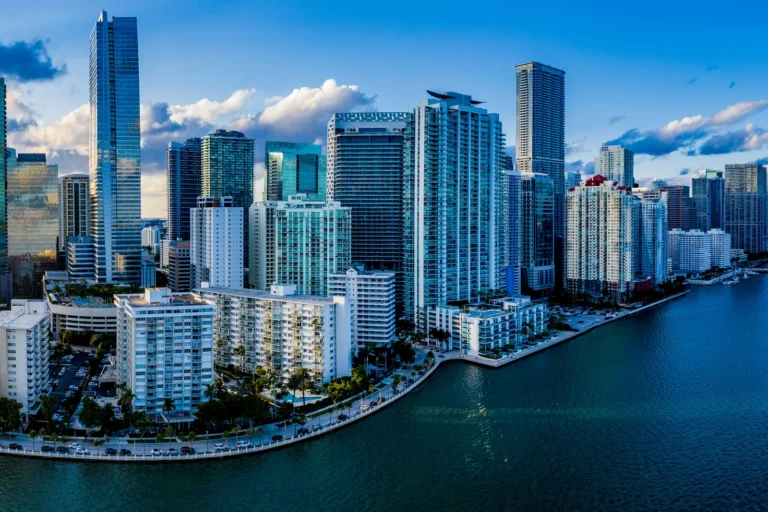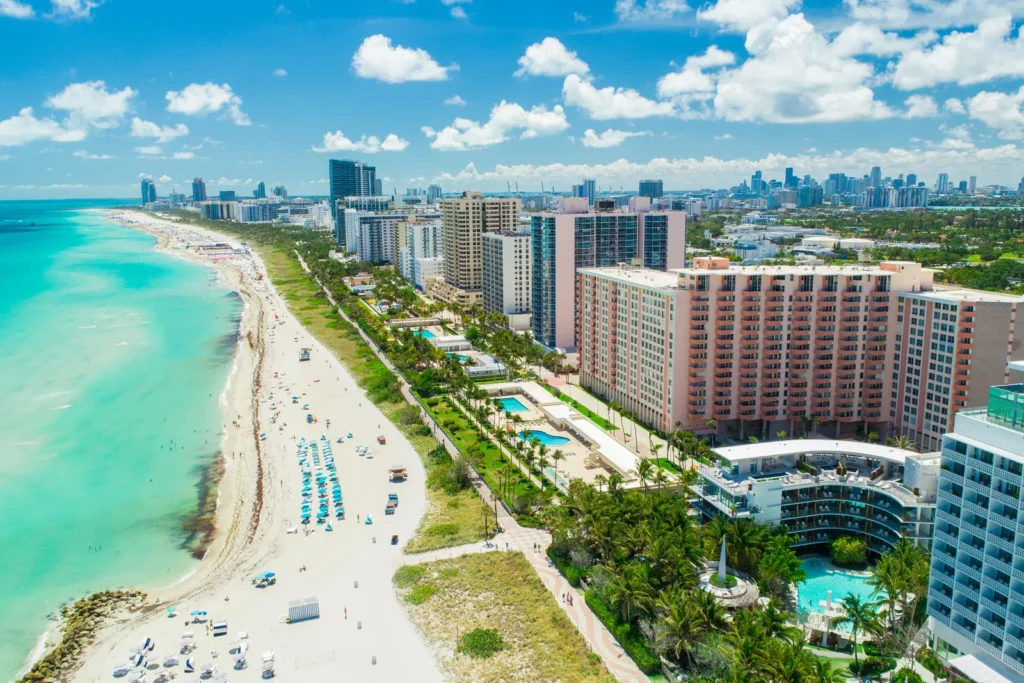
Miami Beach is a Miami-Dade County city on a seven-mile barrier island, so flood elevation rules, a large historic-district footprint, and strict short-term rental limits shape most home purchases there.
This guide walks through the questions that matter before buying or selling a home in Miami Beach: what the island is, how flood and storm-surge rules work, what historic designation means, how rental limits apply, what condo buyers should check, and how taxes and transportation work. Every rule below is linked to the official source it came from.
What are the basic facts about Miami Beach?
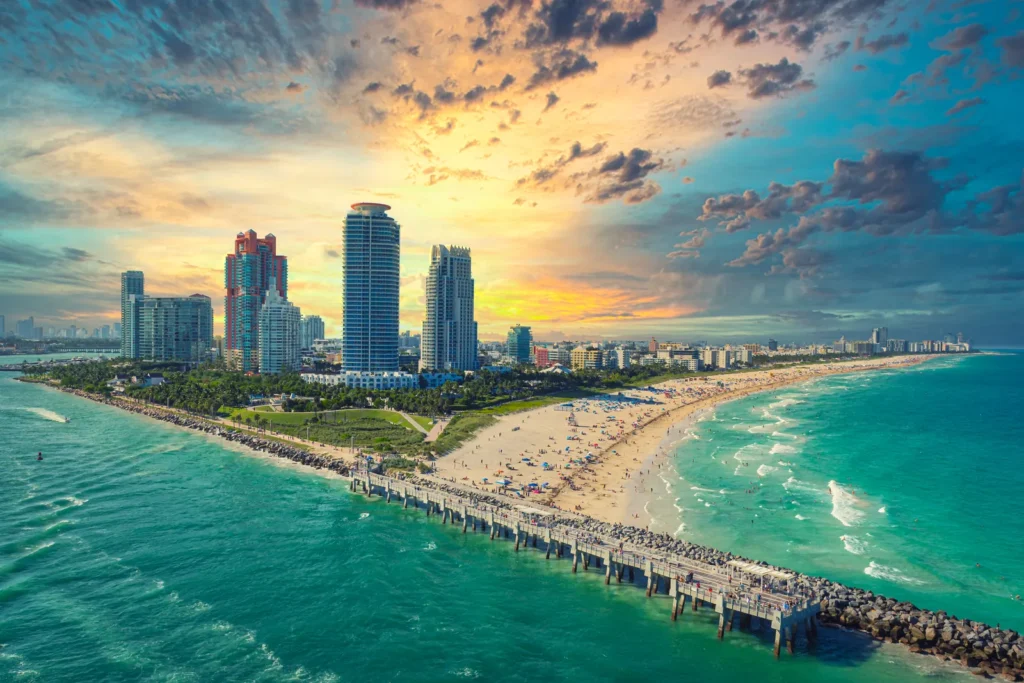
Miami Beach is an incorporated city in Miami-Dade County, surrounded by the Atlantic Ocean to the east and Biscayne Bay to the west. The city’s own annual financial report describes it as sitting on a seven-mile barrier island and says the city is often divided into three main districts: South Beach, Mid-Beach, and North Beach.
| Item | What the official source says |
|---|---|
| County | Miami-Dade County |
| Incorporated | March 26, 1915, per the city’s history page |
| Population | Approximately 82,965, per the city’s fiscal year 2023 annual financial report |
| Government | Elected Mayor and six Commissioners, commission-manager form (same report) |
| Setting | Seven-mile barrier island between the Atlantic Ocean and Biscayne Bay (same report) |
| Districts | South Beach, Mid-Beach, North Beach (same report) |
| School district | Miami-Dade County Public Schools |
| Nearest airports | Miami International about 10 miles west; Fort Lauderdale/Hollywood International approximately 25 to 30 minutes north, per the city’s getting around page |
The city also reports over 40 parks and facilities on its parks and recreation page. When LPE Realty reviews a Miami Beach purchase, the first question is which of the three districts the property is in, because flood exposure, building age, and zoning change from one end of the island to the other.
How do flood zones and elevation rules affect a Miami Beach purchase?
Flood rules are the first thing to check, because the city’s own resilient-construction fact sheet says 93% of Miami Beach buildings sit in a FEMA special flood hazard area and 64% were built before the FEMA flood maps that require higher construction. That sheet is dated December 2019, so treat the percentages as a dated city figure.
- Higher than FEMA requires. The fact sheet says Miami Beach requires new construction to be more than one to five feet higher than base flood elevation.
- Elevation certificate. The fact sheet advises obtaining an elevation certificate when the lowest floor slab is poured and before the final building inspection. The city’s flood protection page says it has collected FEMA elevation certificates since 1995 and that a certificate can potentially lower insurance premiums.
- The 50% rule. If a house in a flood zone is damaged or improved by more than 50% of its building market value, the city says the lowest floor must be raised to meet the current elevation requirement.
- Which map applies. Miami-Dade County states that the current FEMA maps became effective on September 11, 2009. Preliminary maps published in 2021 are not in effect. The county offers an address lookup tool and a Flood Zone Hotline at 305-372-6466.
When LPE Realty reviews a Miami Beach purchase, we pull the flood zone and any elevation certificate before the buyer spends money on inspections. For insurance and coastal due diligence, see the windstorm and flood insurance guide.
What do hurricane storm surge zones mean for a Miami Beach address?
Storm surge zones are separate from flood zones. Miami-Dade County uses five zones, A through E, to show surge risk: Zone A is at risk from Category 1 and higher storms, Zone B from Category 2 and higher, Zone C from Category 3 and higher, Zone D from Category 4 and higher, and Zone E from Category 5 storms.
The county’s Know Your Zone map lets you enter an address to see its zone. A buyer should look up the zone for any Miami Beach address and keep it with the flood zone result, since the two answer different questions.
How does historic designation affect buying or renovating?
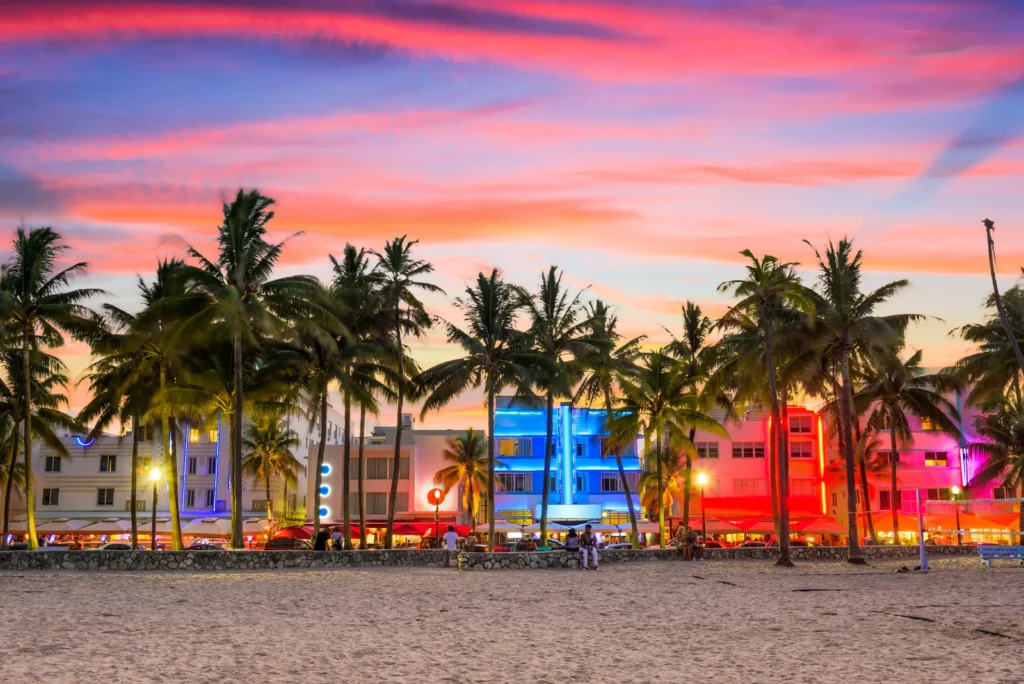
Miami Beach has local historic districts, and a property inside one can face preservation review before exterior changes. The city says its historic districts include over 2,600 buildings, about 70% of them contributing, on its architecture page. The same page states that on May 14, 1979, the Miami Beach Architectural District became the nation’s first urban 20th-century historic district listed on the National Register of Historic Places.
- The city identifies Art Deco and MiMo (Miami Modern) as architectural styles found in its districts.
- The city names Espanola Way, Ocean Drive, and Flamingo Park among the areas its historic districts cover.
- Tax incentives are available to qualifying historic properties, according to the city.
Before an offer on a home in or near a district, confirm with the city whether the property is designated and what review a planned renovation would need.
Can I rent out a Miami Beach home on a short-term basis?
Usually not. The city’s vacation and short-term rental page defines a short-term rental as less than six months and one day, and says these rentals are prohibited in all single-family homes and in many multifamily buildings in certain zoning districts.
Where a building is authorized, the owner needs a Vacation/Short-Term Rental Business Tax Receipt and a Resort Tax account, and the city requires rental advertisements to display those numbers. A buyer counting on short-term rental income should check the city’s zoning map and authorized building list for the exact building before writing an offer.
What should condo buyers check in Miami Beach?
Buyers of older condominiums should ask for the building’s milestone inspection status. Under Florida Statutes section 553.899, a building of three habitable stories or more that is subject to condominium or cooperative ownership must have a milestone inspection by December 31 of the year it reaches 30 years of age. A local enforcement agency may move that to 25 years for local conditions such as proximity to salt water.
- Phase one is a visual examination by a licensed architect or engineer, to be completed within 180 days after the owner receives written notice.
- Phase two is required only if phase one finds substantial structural deterioration.
When LPE Realty reviews a Miami Beach condo purchase, the inspection report and the association’s reserve documents are among the first items requested. Our milestone inspection and SIRS guide and condo buying guide cover the documents in detail.
How are Miami Beach property taxes set?
A Miami Beach tax bill combines the city’s rate with county, school, and special district rates. The Property Appraiser’s 2025 proposed millage table lists Miami Beach under two millage codes, 0200 and 0201, so confirm which code applies to a specific parcel.
| 2025 proposed millage, code 0200 | Mills |
|---|---|
| City of Miami Beach operating | 5.8702 |
| City of Miami Beach debt service | 0.2779 |
| Total, all taxing authorities | 18.7761 |
These are proposed figures from August 2025, and final rates can differ, so check the current bill for any parcel. For a primary residence, the Property Appraiser’s homestead page says applications must be submitted by March 1, and that the owner needs title and permanent residence on the property as of January 1. Our homestead and Save Our Homes guide explains how the cap works after a purchase.
How do you get around Miami Beach and reach the airports?
Three causeways connect the island to the mainland, according to the city’s driving directions: the Julia Tuttle Causeway (I-195) and the 79th Street Causeway for North Beach and Mid-Beach, and the MacArthur Causeway (I-395), which becomes 5th Street, for South Beach.
Inside the city, the free trolley runs from 8 a.m. to 11 p.m., seven days a week, at about a 20-minute average frequency on four routes: South Beach Loop, Middle Beach Loop, Collins Express, and North Beach Loop. The getting around page also lists a free water taxi, Citi Bike, Freebee on-demand transit, and Miami-Dade Metrobus and Metrorail information.
Frequently asked questions
Is every Miami Beach property in a flood zone?
Not necessarily, but most are. The city’s December 2019 fact sheet said 93% of buildings were in a FEMA special flood hazard area. Check the specific address with the county’s flood zone lookup.
What is an elevation certificate?
It is a FEMA document showing a building’s lowest floor elevation. The city says it shows how high a house was built in relation to its flood zone and can potentially lower insurance premiums.
What does the 50% rule mean for a renovation?
If a house in a flood zone is damaged or improved by more than 50% of its building market value, the city says the lowest floor must be raised to meet current elevation requirements.
How do I find the assigned school for a Miami Beach address?
Schools are run by Miami-Dade County Public Schools. Ask the district for the attendance zone of the exact address rather than relying on a map or a general description.
What is the deadline to apply for homestead exemption?
The Miami-Dade Property Appraiser says applications and required documents must be submitted by March 1.
Ready to take the next step? Talk with us about how to buy with LPE Realty or sell with LPE Realty. LPE Realty LLC is a licensed Florida real estate brokerage.