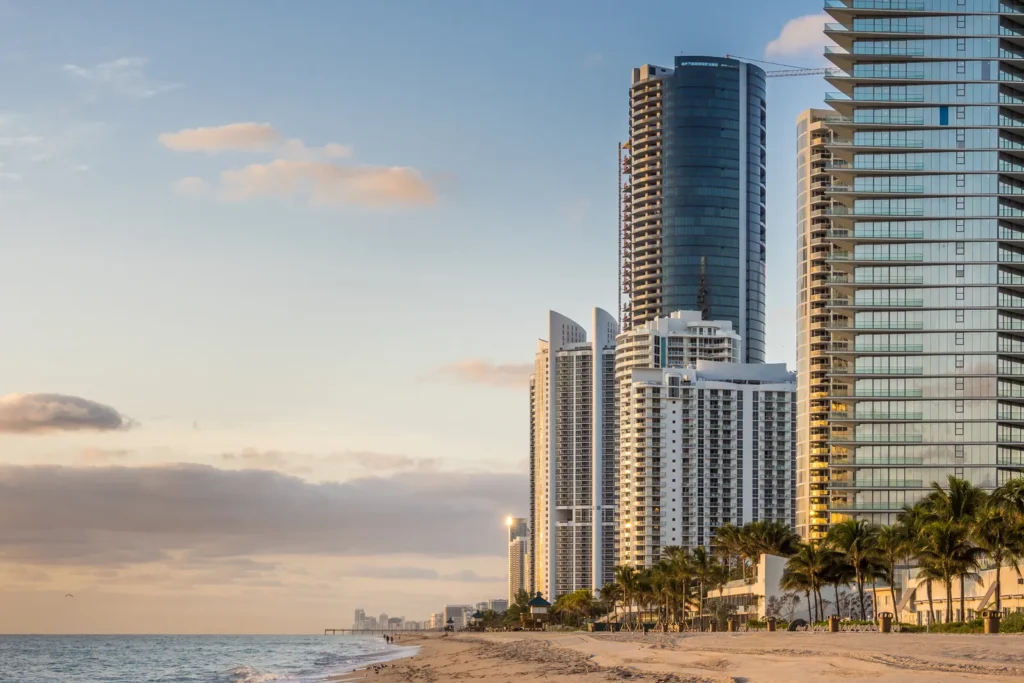
Fontainebleau is an unincorporated community in Miami-Dade County, Florida, so the county, not a city, handles its zoning and permits, and the checks that matter most are association paperwork, flood and storm surge status, and the county homestead process.
This guide covers who governs Fontainebleau, how permits and zoning work there, how the county homestead exemption affects a buyer, what Florida law says about condominium and association purchases, how flood maps and evacuation zones apply, and how to confirm an address’s assigned schools. Rules are linked to official sources.
Is Fontainebleau a city, or does Miami-Dade County govern it?
Fontainebleau is not a city, so Miami-Dade County is the local government for its residents and property owners. The U.S. Census Bureau tracks the area as a census-designated place (CDP), which is a statistical boundary, not a government. In the Census Bureau’s 2020 place file the name is spelled Fountainebleau CDP.
| Item | What the official record shows |
|---|---|
| County | Miami-Dade County |
| Type of place | Unincorporated community; the Census Bureau treats it as a CDP |
| Census name | Fountainebleau CDP (place code 1224562) |
| Population | 59,870 at the 2020 Census (same Census Bureau place file) |
| Land area | About 3.96 square miles (10,249,007 square meters in the 2020 Census boundary file) |
| Public school district | Miami-Dade County Public Schools |
| Commercial airport | Miami International Airport (MIA) |
Who handles zoning, building permits and code rules in Fontainebleau?
Miami-Dade County handles them. The county’s Review and Permitting Hub says that inside a city, the local city handles zoning and building permitting, and in the unincorporated area those functions fall under Miami-Dade County. When LPE Realty reviews a Fontainebleau purchase, one of the first steps is confirming whether the exact address sits in unincorporated Miami-Dade or inside a neighboring city, because that decides which office issues permits and enforces code.
For unincorporated property, the hub explains who issues what:
- Building, environmental and zoning permits come from the county’s Department of Regulatory and Economic Resources, and plan review checks the Florida Building Code, the Miami-Dade County Code and environmental requirements.
- Work in the public right-of-way, such as roads, sidewalks, traffic and drainage, goes through the county’s transportation department.
- Water and sewer approvals come from the county’s water and sewer department.
- Fire protection permits and inspections come from the county’s fire rescue department.
The county’s Zoning and Development Services page states that each property in Miami-Dade County is assigned a zoning district classification, and that a zoning hearing is required when an owner wants to change how land is used. Before planning an addition or a business use, get written zoning verification for the address.
Land use planning follows the county’s Comprehensive Development Master Plan, which sets broad goals for where and how land is developed or conserved over the next 10 to 20 years and is reviewed every seven years. Zoning and land use decisions in unincorporated areas are also handled through the county’s Community Councils. Each council serves one of 10 geographic areas, with six elected members and one appointed by the Board of County Commissioners. The page does not name Fontainebleau, so use its “Find your Community Council” tool for a specific address.
How do the homestead exemption and property taxes work for a Fontainebleau buyer?
A buyer who makes the home a permanent residence applies for homestead with the Miami-Dade Property Appraiser by March 1, and must hold title and live there as of January 1 of that tax year. The Property Appraiser’s homestead page lists the qualifying rules and the accepted proof of residence, including a Florida driver’s license or ID, vehicle registration, voter registration, a prior-year IRS return or current W-2, or a recorded Declaration of Domicile.
The Save Our Homes cap is the second piece. According to the Property Appraiser’s explanation, it limits the annual increase in a homesteaded home’s assessed value to 3 percent or the Consumer Price Index, whichever is lower. The same page says the limitation transfers to another owner only in listed cases: transfers between spouses, transfers to legal or natural dependents of the previous exemption holder, and transfers made to correct an error.
In practice, a seller’s current tax bill may reflect exemptions and a cap that a buyer will not inherit. LPE Realty advises buyers to open the property’s record in the Property Appraiser’s Property Search, which shows ownership, sales, and assessment, exemption and taxable values, and to use the tax estimator on the Property Appraiser’s site instead of copying the seller’s bill.
What should a buyer check on a condominium or association-governed home in Fontainebleau?
Ask for the association’s documents before you rely on the monthly fee, because Florida statutes tie reserves, inspections and unpaid assessments to the building and, in some cases, to the buyer. This guide cannot say which buildings in the community fall under which rule, because a building’s height, age and legal form decide that. These are the statutes to know:
| Florida law | What it says | What to ask for |
|---|---|---|
| Section 718.112 | A condominium building three habitable stories or higher needs a structural integrity reserve study at least every 10 years after the condominium’s creation, covering items such as the roof, structure, fire protection, plumbing, electrical, waterproofing and windows. Reserves for those items are based on the study. | The most recent reserve study and the current budget |
| Section 553.899 | A condominium or cooperative building three habitable stories or more needs a milestone inspection by December 31 of the year it reaches 30 years of age, and every 10 years after. A local agency may require it at 25 years where local circumstances, such as nearness to salt water, warrant. | The milestone inspection report, or the date one is due |
| Section 718.116 | A unit owner is jointly and severally liable with the previous owner for unpaid assessments that came due before the owner took title. The association must issue an estoppel certificate within 10 business days of a request. | An estoppel certificate showing what is owed |
| Section 720.401 | A buyer in a homeowners’ association community must receive a disclosure summary before signing. If it is not provided, the buyer may void the contract by written notice within 3 days after receiving it or before closing, whichever comes first. | The disclosure summary and the covenants |
LPE Realty’s condo buying guide covers these in plain terms.
How do flood maps and hurricane evacuation zones apply to a Fontainebleau address?
They answer two different questions, so check both for any address. FEMA flood maps show how likely an area is to flood. FEMA states that areas with a 1 percent or greater chance of flooding each year are considered high risk, that the Flood Map Service Center at msc.fema.gov is the official place to find flood hazard maps, and that flood maps help mortgage lenders determine insurance requirements. Florida law adds a seller duty: under Section 689.302, a seller of residential property must give the buyer a flood disclosure at or before the time the sales contract is signed. It asks about known flood damage, flood insurance claims and flood assistance, including from FEMA.
Evacuation is a separate county process. Miami-Dade’s emergency management page defines a Storm Surge Planning Zone as an area that could be affected by storm surge and links to a map to check. The county’s evacuation guidance says orders are issued by zones or partial zones and that evacuation centers are a shelter of last resort. It also says public transportation may shut down three hours before the storm or when winds exceed 39 mph.
LPE Realty tells buyers to look up the FEMA flood zone and the storm surge planning zone side by side, then talk to an insurance agent before the inspection period ends. Our guide to home insurance when buying lists the questions to ask.
How do you get around from Fontainebleau and reach the airport?
Miami-Dade Transit’s Metrorail Orange Line serves Miami International Airport, so rail is one way to reach MIA from the county. The county’s Metrorail page describes a 25-mile dual-track system with a Green Line from Palmetto to Dadeland South and an Orange Line that runs to MIA, operating from 5 a.m. to midnight. The county’s airport site tells rail travelers to transfer at Earlington Heights station for the Orange Line train to MIA. Schedules change, so check the county transportation page.
The official sources do not tie a station to a specific Fontainebleau address, so measure the actual route from the home to the nearest stop.
How do you find the assigned school for a Fontainebleau home?
Confirm it with the district, because an assigned school depends on the exact address. Public schools in Miami-Dade County are run by Miami-Dade County Public Schools, whose site is dadeschools.net. Use the district’s own school-assignment tools with the full street address, and confirm again near your offer date. This guide does not rate or compare schools.
Frequently asked questions
Does Fontainebleau have its own mayor or city hall?
No. Fontainebleau is an unincorporated community, so there is no city government of its own. Permits, zoning and building rules for unincorporated addresses are handled by Miami-Dade County.
Why does the Census spell it Fountainebleau?
The Census Bureau’s 2020 place file lists the CDP as “Fountainebleau.” If you look up population or housing data by name, try that spelling as well.
How can I tell whether an address is in a city or in unincorporated Miami-Dade?
Use the county’s Review and Permitting Hub, which links to the municipalities list and the Government Boundaries Map. If an address falls inside a city, that city issues zoning and building permits instead of the county.
Will I need flood insurance on a Fontainebleau home?
It depends on the address’s FEMA flood zone and on your lender. FEMA says flood maps help lenders determine insurance requirements, so look up the zone at the FEMA Flood Map Service Center and ask your lender early.
Can I keep the seller’s Save Our Homes cap?
Usually not. The Property Appraiser says the limitation transfers to another owner only between spouses, to legal or natural dependents of the previous exemption holder, or to correct an error.
If you are weighing a Fontainebleau purchase or a sale, buy with LPE Realty or sell with LPE Realty. LPE Realty LLC is a licensed Florida real estate brokerage.